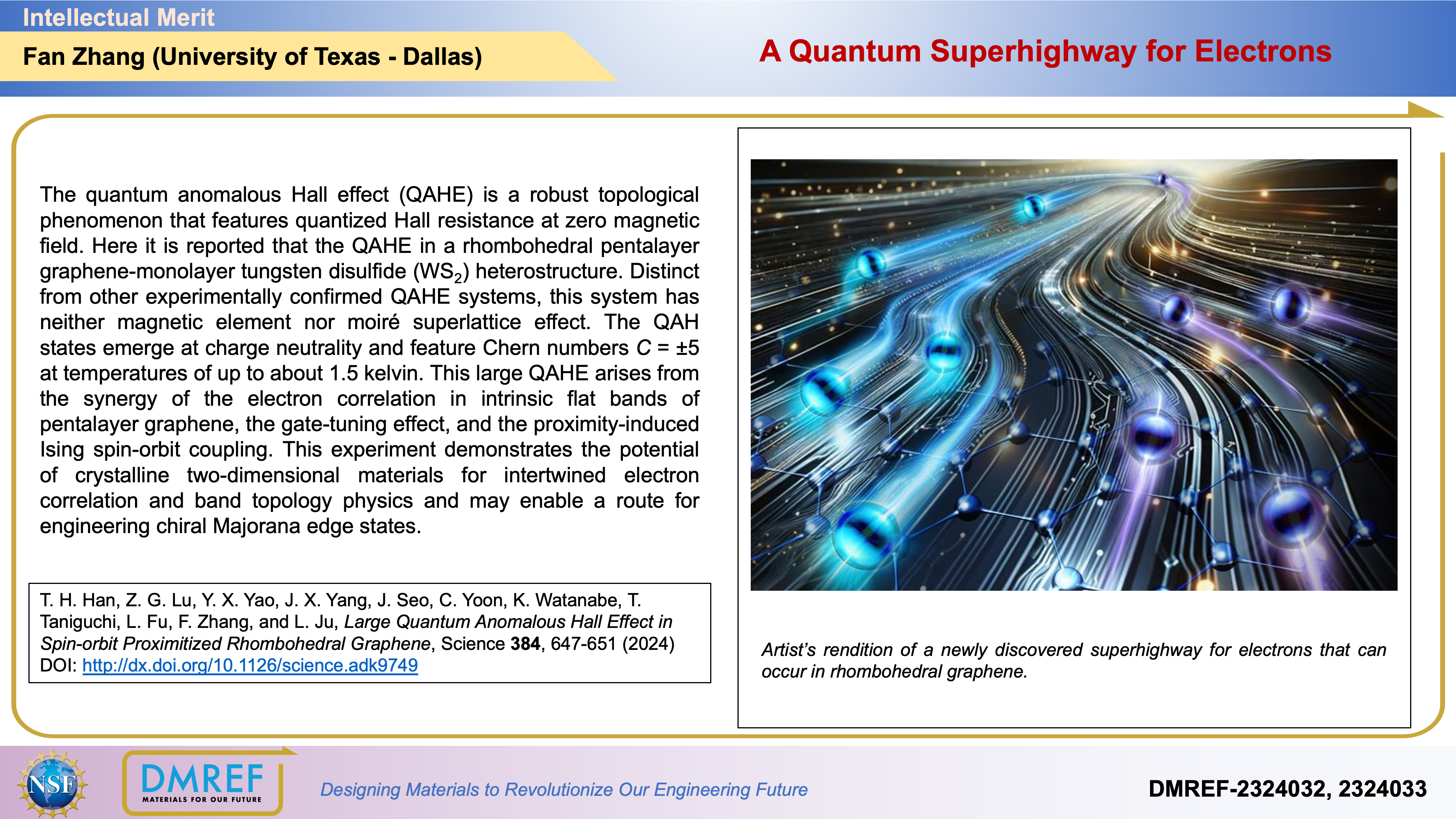
A Quantum Superhighway for Electrons

The quantum anomalous Hall effect (QAHE) is a robust topological phenomenon that features quantized Hall resistance at zero magnetic field. Here it is reported that the QAHE in a rhombohedral pentalayergraphene-monolayer tungsten disulfide (WS2) heterostructure. Distinct from other experimentally confirmed QAHE systems, this system has neither magnetic element nor moiré superlattice effect.
The QAH states emerge at charge neutrality and feature Chern numbers C = ±5 at temperatures of up to about 1.5 kelvin. This large QAHE arises from the synergy of the electron correlation in intrinsic flat bands of pentalayer graphene, the gate-tuning effect, and the proximity-induced Ising spin-orbit coupling. This experiment demonstrates the potential of crystalline two-dimensional materials for intertwined electron correlation and band topology physics and may enable a route for engineering chiral Majorana edge states.