Pressure Tuning of Competing Interactions on a Honeycomb Lattice
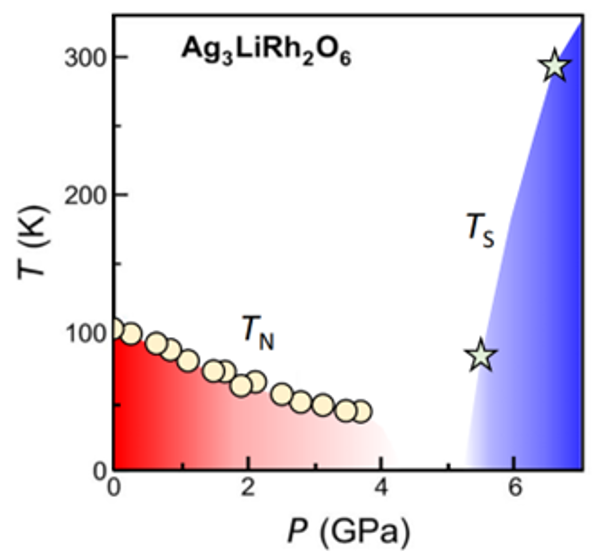
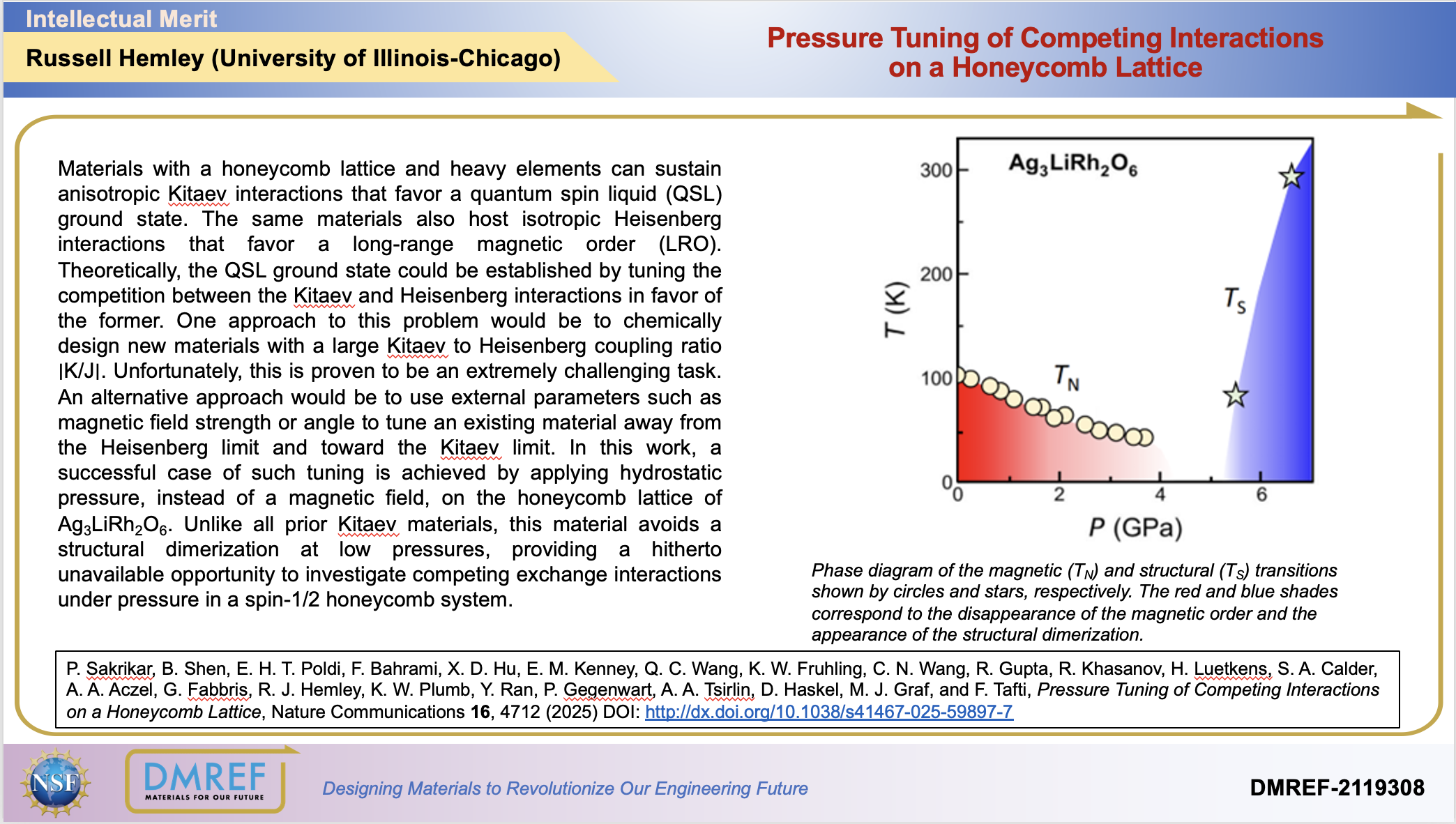
Materials with a honeycomb lattice and heavy elements can sustain anisotropic Kitaev interactions that favor a quantum spin liquid (QSL) ground state. The same materials also host isotropic Heisenberg interactions that favor a long-range magnetic order (LRO). Theoretically, the QSL ground state could be established by tuning the competition between the Kitaev and Heisenberg interactions in favor of the former. One approach to this problem would be to chemically design new materials with a large Kitaevto Heisenberg coupling ratio ∣K/J∣. Unfortunately, this is proven to be an extremely challenging task. An alternative approach would be to use external parameters such as magnetic field strength or angle to tune an existing material away from the Heisenberg limit and toward the Kitaev limit. In this work, a successful case of such tuning is achieved by applying hydrostatic pressure, instead of a magnetic field, on the honeycomb lattice of Ag3LiRh2O6. Unlike all prior Kitaev materials, this material avoids a structural dimerization at low pressures, providing a hitherto unavailable opportunity to investigate competing exchange interactions under pressure in a spin-1/2 honeycomb system.