Van der Waals Quantum Dots on Layered Hexagonal Boron Nitride
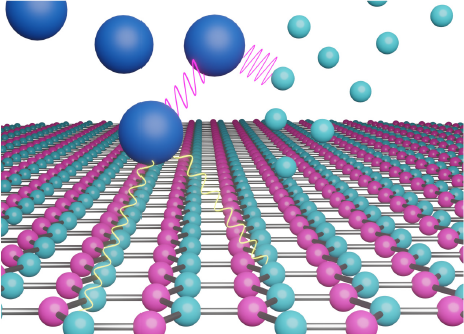
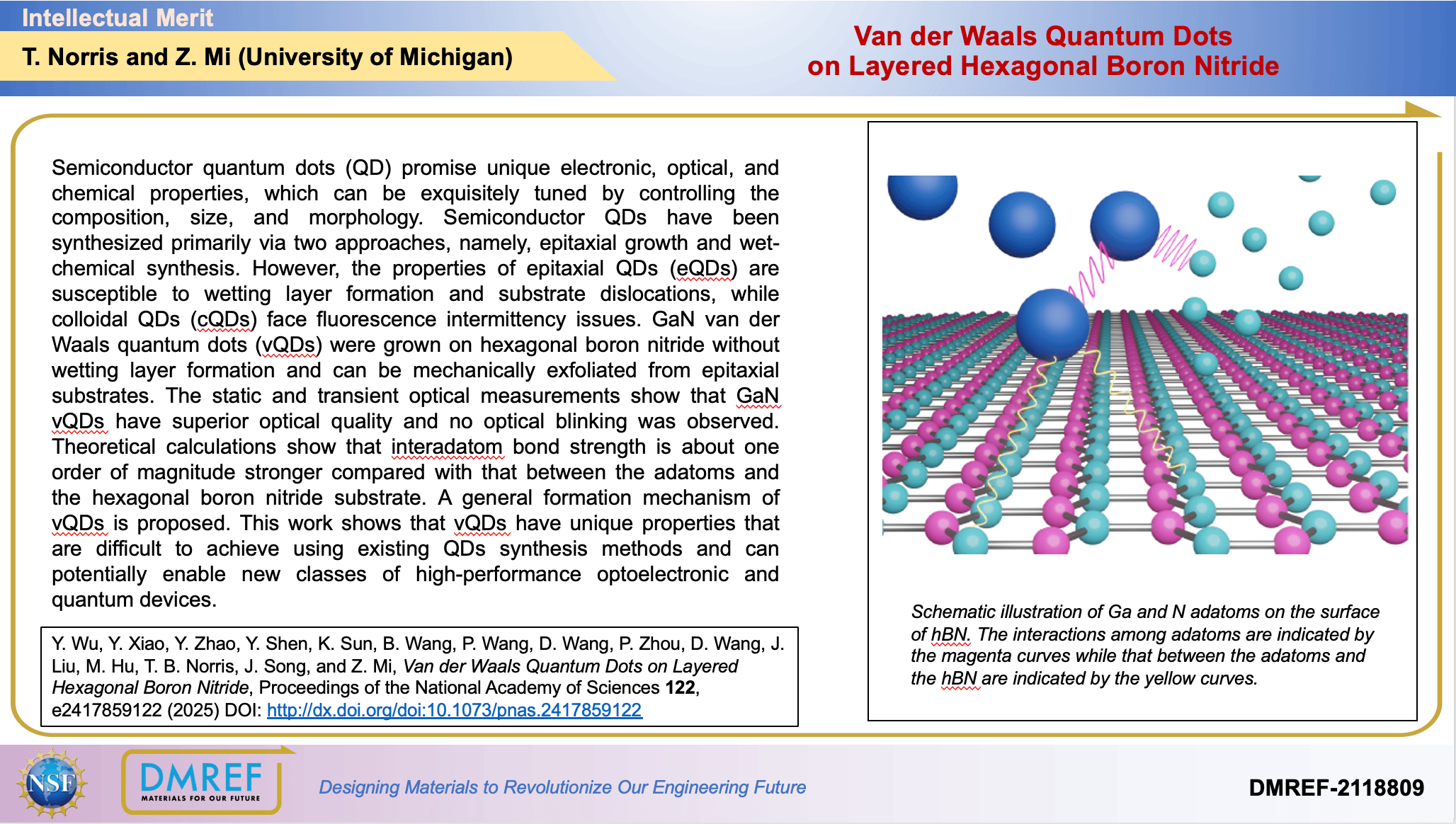
Semiconductor quantum dots (QD) promise unique electronic, optical, and chemical properties, which can be exquisitely tuned by controlling the composition, size, and morphology. Semiconductor QDs have been synthesized primarily via two approaches, namely, epitaxial growth and wet-chemical synthesis. However, the properties of epitaxial QDs (eQDs) are susceptible to wetting layer formation and substrate dislocations, while colloidal QDs (cQDs) face fluorescence intermittency issues. GaN van der Waals quantum dots (vQDs) were grown on hexagonal boron nitride without wetting layer formation and can be mechanically exfoliated from epitaxial substrates. The static and transient optical measurements show that GaN vQDs have superior optical quality and no optical blinking was observed. Theoretical calculations show that interadatom bond strength is about one order of magnitude stronger compared with that between the adatoms and the hexagonal boron nitride substrate. A general formation mechanism of vQDs is proposed. This work shows that vQDs have unique properties that are difficult to achieve using existing QDs synthesis methods and can potentially enable new classes of high-performance optoelectronic and quantum devices.