High-throughput Computational Screening of Hydrocarbon Molecules for Long-wavelength Infrared Imaging
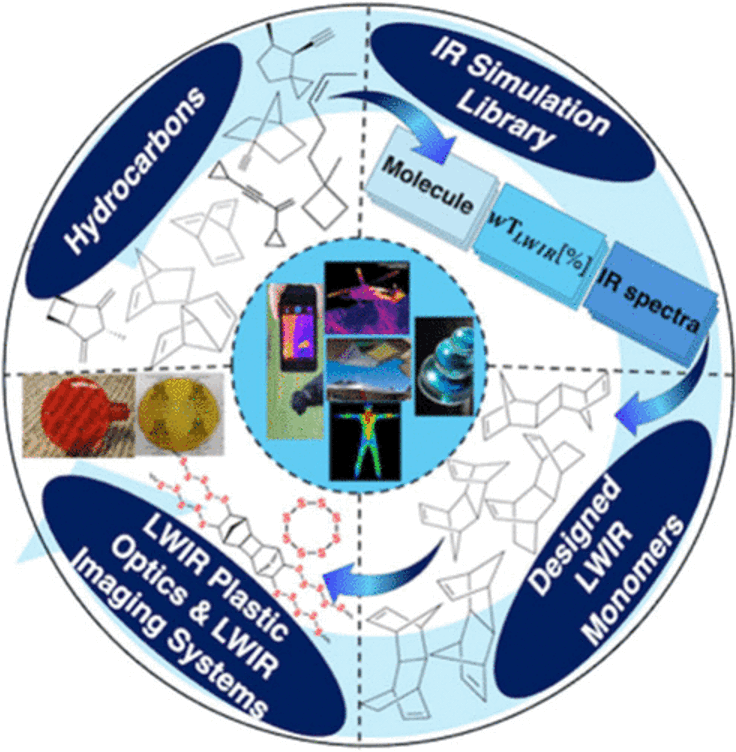
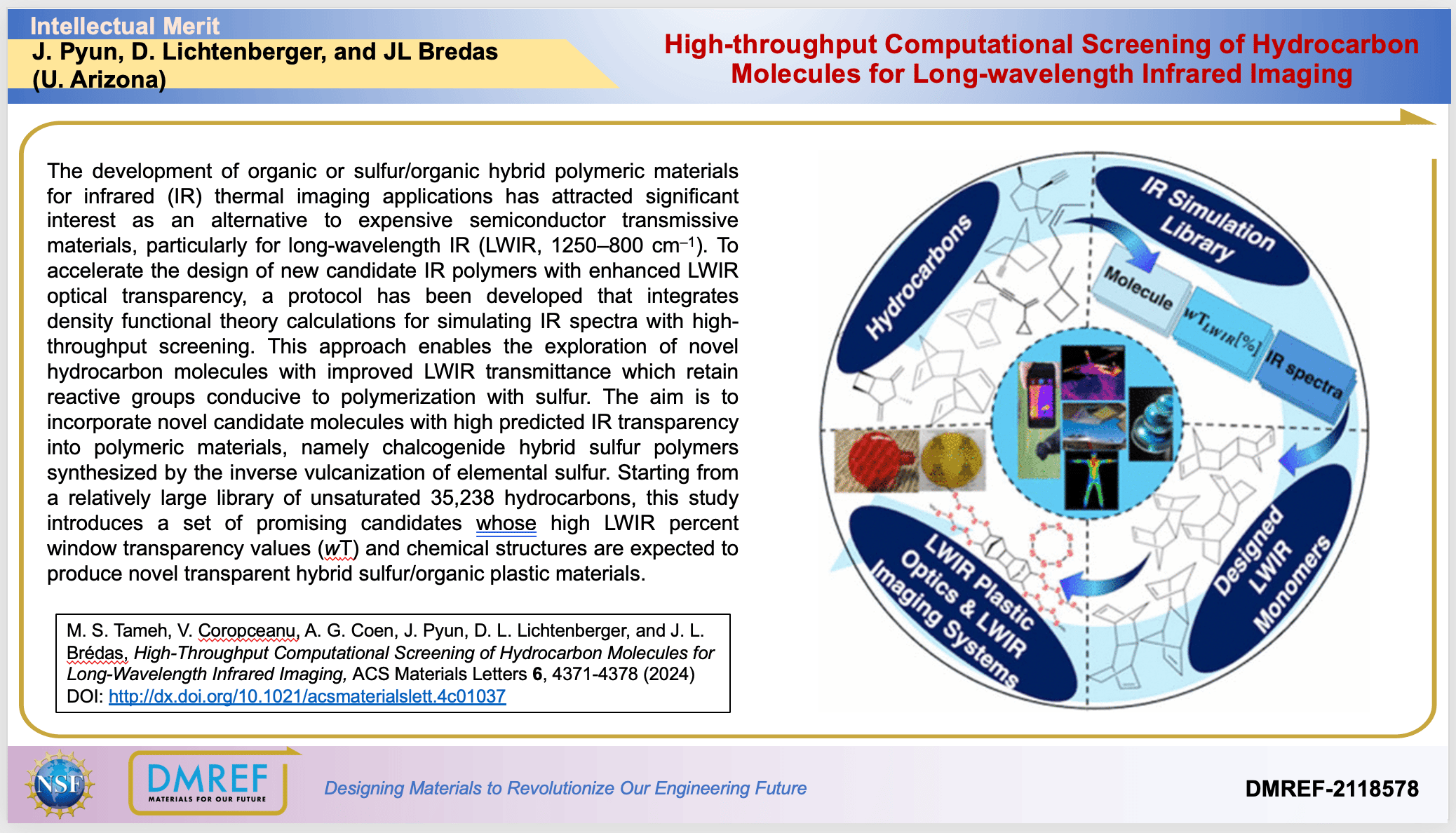
The development of organic or sulfur/organic hybrid polymeric materials for infrared (IR) thermal imaging applications has attracted significant interest as an alternative to expensive semiconductor transmissive materials, particularly for long-wavelength IR (LWIR, 1250–800 cm–1). To accelerate the design of new candidate IR polymers with enhanced LWIR optical transparency, a protocol has been developed that integrates density functional theory calculations for simulating IR spectra with high-throughput screening. This approach enables the exploration of novel hydrocarbon molecules with improved LWIR transmittance which retain reactive groups conducive to polymerization with sulfur. The aim is to incorporate novel candidate molecules with high predicted IR transparency into polymeric materials, namely chalcogenide hybrid sulfur polymers synthesized by the inverse vulcanization of elemental sulfur. Starting from a relatively large library of unsaturated 35,238 hydrocarbons, this study introduces a set of promising candidates whose high LWIR percent window transparency values (wT) and chemical structures are expected to produce novel transparent hybrid sulfur/organic plastic materials.