Artificial Intelligence Guided Search for Chalcogenide Hybrid Inorganic / Organic Polymers Comonomers
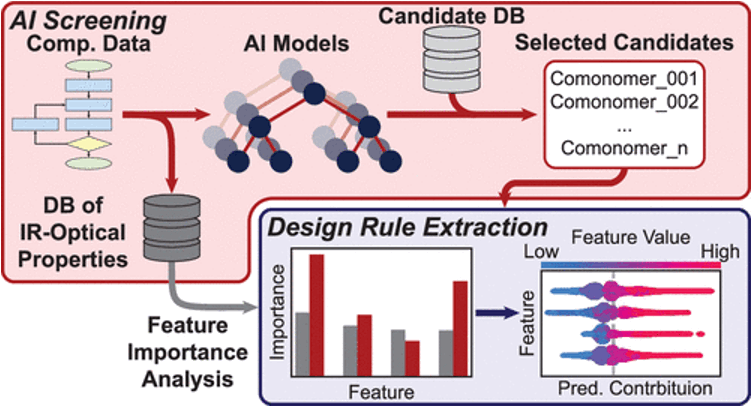
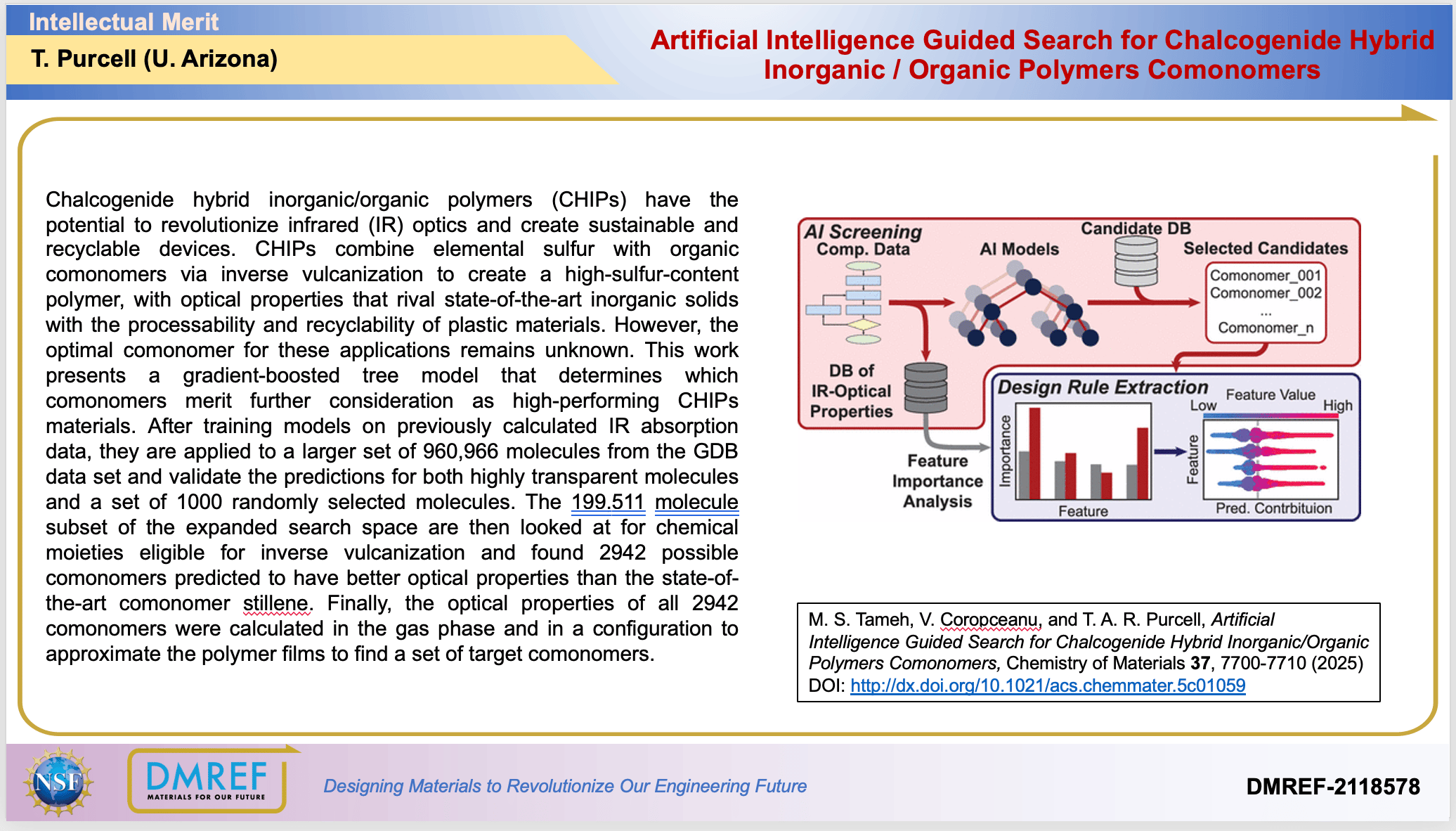
Chalcogenide hybrid inorganic/organic polymers (CHIPs) have the potential to revolutionize infrared (IR) optics and create sustainable and recyclable devices. CHIPs combine elemental sulfur with organic comonomers via inverse vulcanization to create a high-sulfur-content polymer, with optical properties that rival state-of-the-art inorganic solids with the processability and recyclability of plastic materials. However, the optimal comonomer for these applications remains unknown. This work presents a gradient-boosted tree model that determines which comonomers merit further consideration as high-performing CHIPs materials. After training models on previously calculated IR absorption data, they are applied to a larger set of 960,966 molecules from the GDB data set and validate the predictions for both highly transparent molecules and a set of 1000 randomly selected molecules. The 199,511 moleculesubset of the expanded search space are then looked at for chemical moieties eligible for inverse vulcanization and found 2942 possible comonomers predicted to have better optical properties than the state-of-the-art comonomer stillene. Finally, the optical properties of all 2942 comonomers were calculated in the gas phase and in a configuration to approximate the polymer films to find a set of target comonomers.