A New View of Grain Boundary Migration in Polycrystals

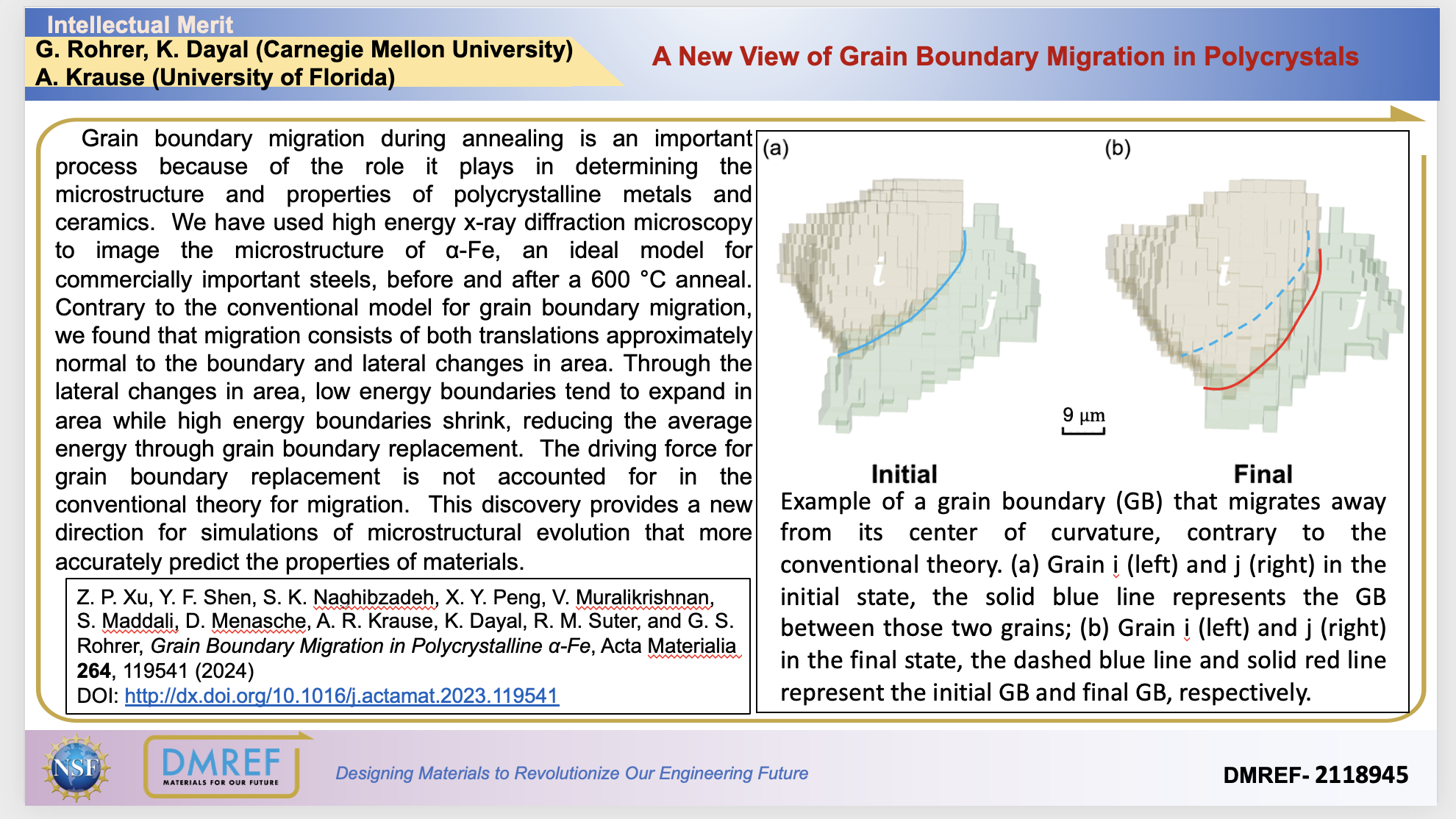
Grain boundary migration during annealing is an important process because of the role it plays in determining the microstructure and properties of polycrystalline metals and ceramics. We have used high energy x-ray diffraction microscopy to image the microstructure of α-Fe, an ideal model for commercially important steels, before and after a 600 °C anneal. Contrary to the conventional model for grain boundary migration, we found that migration consists of both translations approximately normal to the boundary and lateral changes in area. Through the lateral changes in area, low energy boundaries tend to expand in area while high energy boundaries shrink, reducing the average energy through grain boundary replacement. The driving force for grain boundary replacement is not accounted for in the conventional theory for migration. This discovery provides a new direction for simulations of microstructural evolution that more accurately predict the properties of materials.