Research Highlights
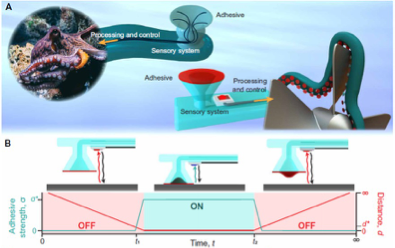
Octopus-inspired Adhesive Skins for Intelligent and Rapidly Switchable Underwater Adhesion
5/30/2024 | Michael Bartlett (Virginia Tech.)
The octopus couples controllable adhesives with intricately embedded sensing, processing, and control to manipulate underwater objects. Current synthetic adhesive–based manipulators are typically manually operated without sensing or control and can be slow to activate and release adhesion, which limits system-level manipulation. Here, we couple switchable, octopus-inspired adhesives with embedded sensing, processing, and control for robust underwater manipulation.
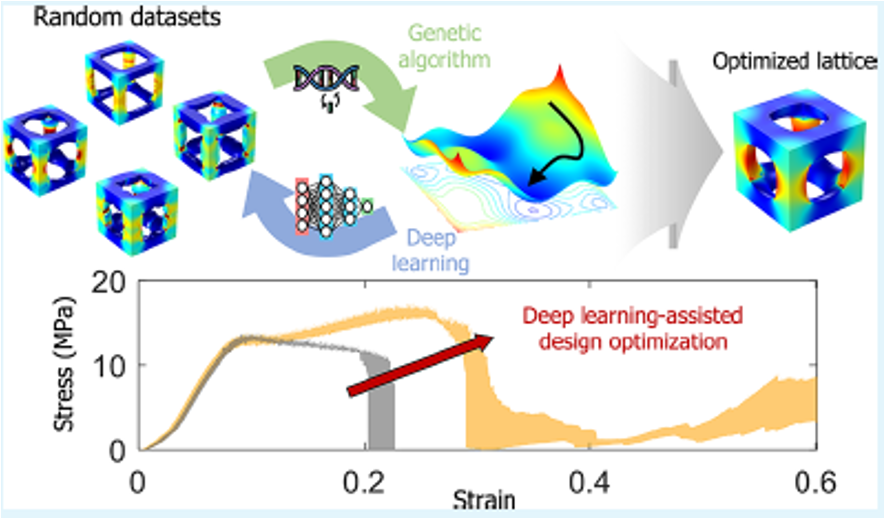
Deep Learning Accelerated Design of Mechanically Efficient Architected Materials
5/30/2024 | Grace Gu (U. CA – Berkeley)
Lattice structures are known to have high performance-to-weight ratios because of their highly efficient material distribution in a given volume. However, their inherently large void fraction leads to low mechanical properties compared to the base material, high anisotropy, and brittleness. Most works to date have focused on modifying the spatial arrangement of beam elements to overcome these limitations, but only simple beam geometries are adopted due to the infinitely large design space associated with probing and varying beam shapes. Herein, we present an approach to enhance the elastic modulus, strength, and toughness of lattice structures with minimal tradeoffs by optimizing the shape of beam elements for a suite of lattice structures.
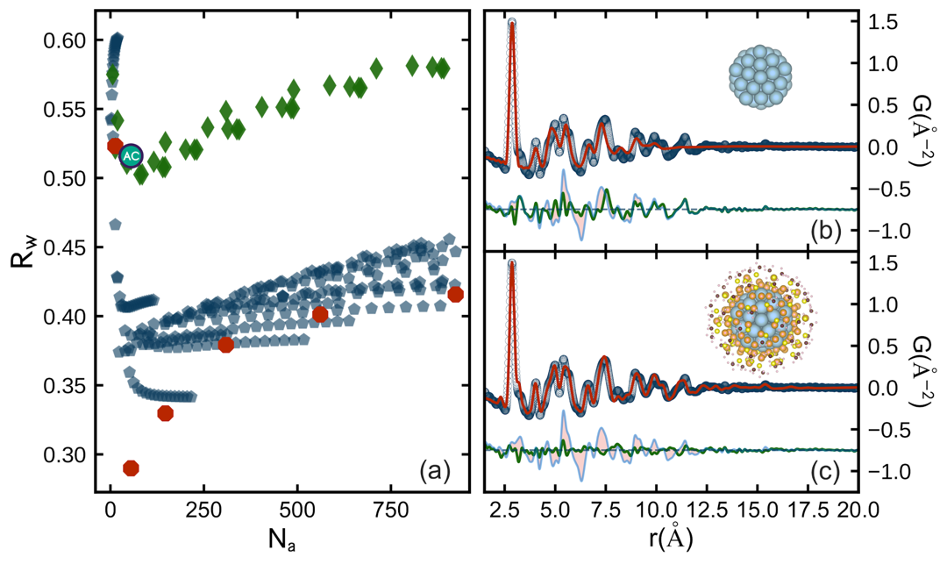
Data-mining our Way to Better Nanoparticle Structures
5/28/2024 | Simon Billinge (Columbia University)
Crystallography has given us the positions of atoms in crystals for 100 years, but nano-particles require a radical rethink in approach. They form interesting non-space-filling structures that we want to synthesize and control for advanced devices, but how to accurately determine the 3D atomic arrangements?
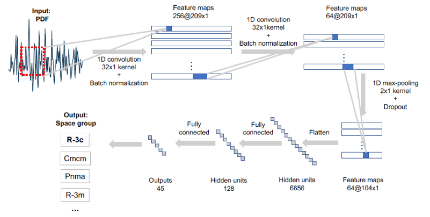
Teaching a Machine to See Symmetry Where We Can’t
5/28/2024 | Daniel Hsu, Qiang Du, Simon Billinge (Columbia University)
Atoms typically arrange themselves in symmetric arrangements making patterns. The first step in any structure solution is determining these symmetries from the diffraction data. But in typical nanoparticle data the underlying symmetries are hidden.

Control of Electronic Properties of MXenes
5/28/2024 | Simon Billinge (Columbia University)
Over the past decade, graphene and other two-dimensional (2D) materials opened new horizons for research, from miniaturizing electronic devices to creating wearable electronics and developing new methods for water desalination and purification. 2D transition metal carbides (MXenes) are among the latest additions.
The Mathematics of Finding Atoms in Nanoparticles
5/28/2024 | Simon Billinge (Columbia University)
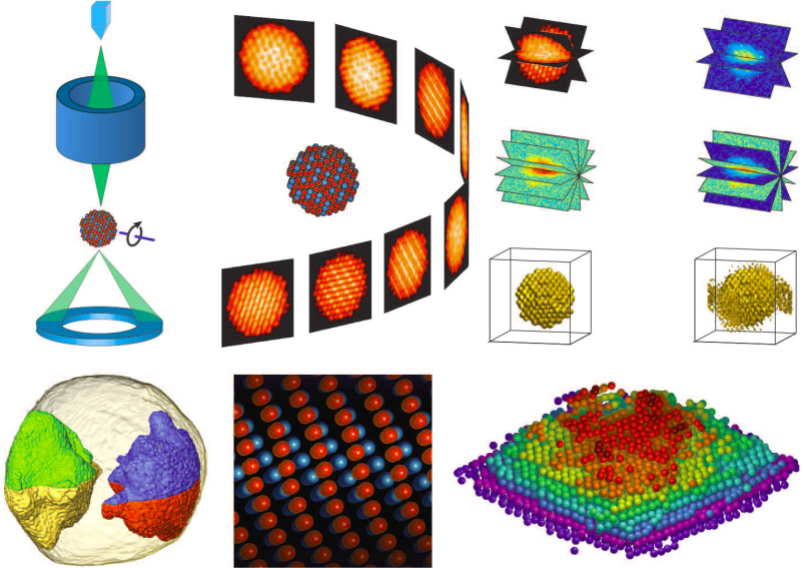
When atoms arrange themselves in crystals, x-ray crystallography can be used to find them. In nanostructures, atoms are much harder to find.

A New View of Grain Boundary Migration in Polycrystals
5/22/2024 | G. Rohrer, K. Dayal (Carnegie Mellon University) A. Krause (University of Florida)
Grain boundary migration during annealing is an important process because of the role it plays in determining the microstructure and properties of polycrystalline metals and ceramics. We have used high energy x-ray diffraction microscopy to image the microstructure of α-Fe, an ideal model for commercially important steels, before and after a 600 °C anneal.
Design Principles for Sodium Superionic Conductors
5/17/2024 | Yifei Mo (University of Maryland)
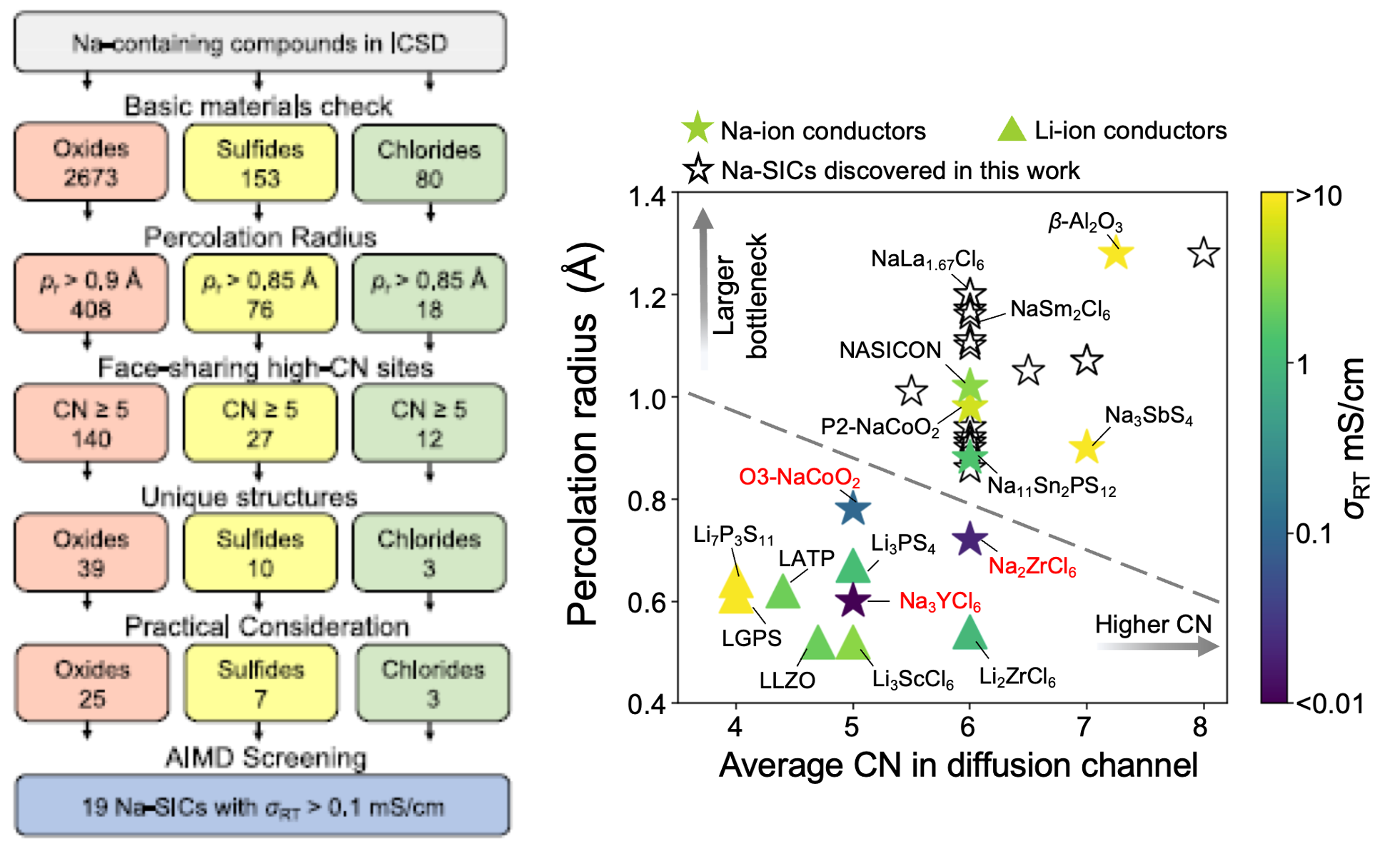
Motivated by the high-performance solid-state lithium batteries enabled by lithium superionic conductors, sodium superionic conductor materials have great potential to empower sodium batteries with high energy, low cost, and sustainability. A critical challenge lies in designing and discovering sodium superionic conductors with high ionic conductivities to enable the development of solid-state sodium batteries.
Anomalously Abrupt Switching of Wurtzite-structured Ferroelectrics
5/14/2024 | Geoff Brennecka (Colorado School of Mines) Jon-Paul Maria (Penn State University)
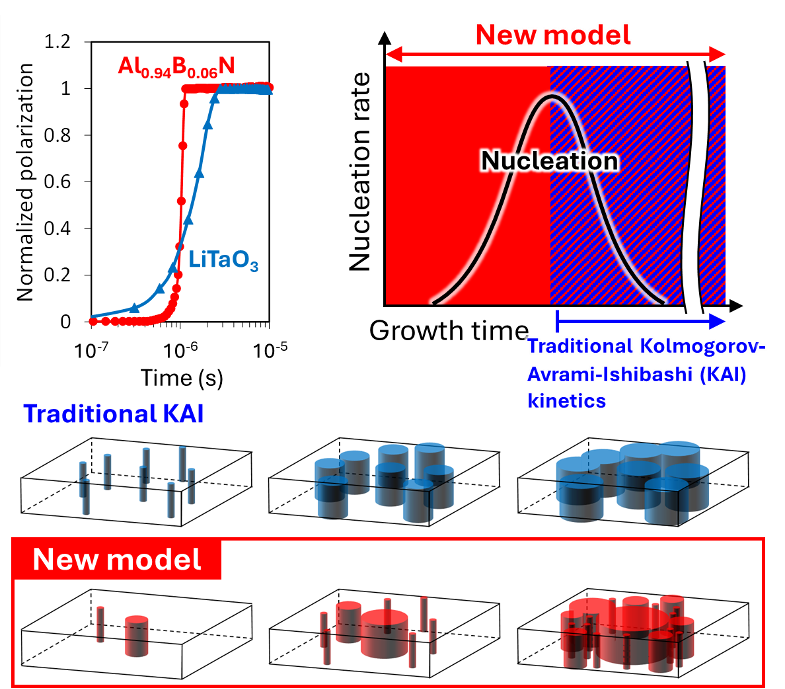
We have extended the classic KAI model to capture scenarios in which significant growth and impingement occur while nucleation rate is increasing. This new approach collapses to the classic KAI model under conditions of pre-existing nuclei, constant or decreasing nucleation rate while for the first time enabling quantitative description of processes in which growth and impingement precede peak nucleation.

Design Principles for Wurtzite-type Ferroelectrics
5/14/2024 | Geoff Brennecka and Prashun Gorai (Colorado School of Mines)
Low-energy compute-in-memory architectures promise to reduce global energy demand for computation and data storage. Wurtzite-type ferroelectrics such as (Al,Sc)N alloy offer potential advantages in both performance and integration with existing semiconductor processes, but at present, all known wurtzite-type ferroelectrics require excessively large operating voltages for polarization reversal. We report a large-scale computational search among multinary compounds for new materials with polarization-switching barriers lower than AlN while maintaining large breakdown fields.
Showing 121 to 130 of 245