Research Highlights

Enhanced Synaptic Memory Window and Linear Planar In2Se3 Ferroelectric Junctions

8/4/2025 | Keji Lai (University of Texas – Austin)

Researchers have made progress in improving neuromorphic computing systems inspired by the brain, addressing limitations of traditional computing. They focused on synaptic memristors made from 2D ferroelectric junctions, which show a voltage memory window of 16 V and an impressive on/off current ratio, leading to very low power consumption of 10^-5 W. Their new design achieved nearly 90% accuracy in on-chip training, providing a promising alternative to traditional computing methods while enhancing performance.

Design Rules to Optimize the Intermolecular Long-range Packing of Organic Semiconductor Crystals

8/1/2025 | Oana Jurchescu (Wake Forest University) John Anthony (University of Kentucky)

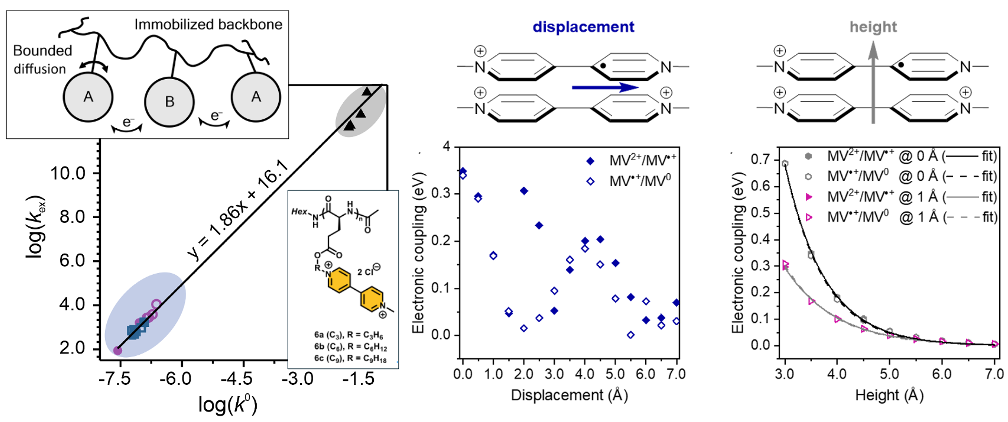
Researchers have investigated how the structure and interactions within organic semiconductors (OSCs), particularly benzodithiophene (BDT) trimers, can be enhanced through fluorine substitutions. Using density functional theory (DFT), they found that these substitutions improve charge mobility by facilitating hydrogen bonding, which helps the molecule adopt a more stable, planar shape. The study highlights the importance of intermolecular interactions in optimizing OSC properties and offers insights for developing better materials for electronics and other applications.

Predicting the Excited-state Properties of Crystalline Organic Semiconductors using Machine Learning

7/9/2025 | Noa Marom (Carnegie Mellon U.)

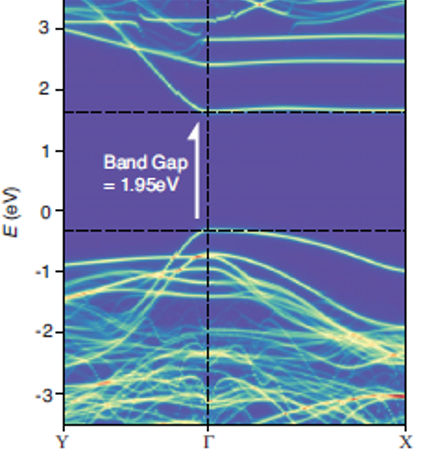
A study explored how machine learning (ML) can help predict key properties of organic semiconductors, which are important for electronic devices. Researchers used the SISSO ML algorithm to develop models predicting various excitation energies in polycyclic aromatic hydrocarbon crystals. By training models on a dataset of advanced calculations, they achieved predictions close to established reference values. This approach can effectively narrow down material choices for further, more detailed evaluation, saving time and resources in material discovery.

Vacuum Deposition of Nonlinear Organic Single Crystal Films on Silicon

7/9/2025 | Noa Marom (Carnegie Mellon U.), Noel Giebink (U. Michigan), Barry Rand (Princeton)

A recent study demonstrated a method to grow large single crystal domains of a nonlinear optical material called OH1 on glass or silicon using vacuum evaporation and thermal annealing. These crystals, which are crucial for enhancing optical functions in silicon photonics, showed strong second harmonic generation and could grow across etched channels on silicon wafers. This advancement could help integrate these materials into photonic circuits, addressing ongoing challenges in the industry.

Discovery of Crystallizable Organic Semiconductors with Machine Learning

7/9/2025 | Barry Rand (Princeton University)

Researchers used machine learning to identify organic materials that can turn into well-structured crystalline films, known as platelets, after heating. They focused on specific thermal properties like melting points. From six materials analyzed, three successfully crystallized into platelets, while one formed a different structure and two did not crystallize at all. This study shows how machine learning can help predict which organic compounds will crystallize effectively, aiding the development of better organic semiconductors.

First Atomic-scale Identification of Hierarchical Moire Structures in 2D Materials

7/7/2025 | P. Kim (Harvard U.) and K. Wang (U. Minnesota)

This study is the first to identify complex structures in trilayer graphene at the atomic level. Unlike previous research focusing on just two layers, this work explores the overlapping of multiple moiré lattices, creating a unique pattern called "moiré-of-moiré." By using advanced imaging and simulations, the researchers mapped how these patterns change based on twist angles. Understanding these structures could lead to better electronic systems and new quantum devices.

First High-temperature Superconducting Diode Made from Thin Cuprate Crystals

7/7/2025 | P. Kim (Harvard U.)

Researchers developed a method to create twisted van der Waals Josephson junctions (JJs) using stacked cuprate crystals. By adjusting the stacking angles, they achieved high-quality junctions with unique properties, such as observable fractional Shapiro steps. They discovered they could control the system to break time-reversal symmetry, enabling reversible Josephson diodes without magnetic fields. These findings pave the way for creating advanced topological devices that work at higher temperatures.

Superconducting Material Stabilized at Ambient Pressure: A Step Toward Real-world Applications

6/25/2025 | Russell Hemley (University of Illinois-Chicago) Eva Zurek (SUNY-Buffalo)

Researchers have made a breakthrough by stabilizing a superconducting material, Bi0.5Sb1.5Te3, at normal pressure. This was achieved using a new technique that allows for the exploration of materials usually only found under extreme conditions. This discovery is crucial because most useful materials exist in metastable states, and stabilizing these materials could lead to better superconductors, benefiting various scientific and technological applications.

Structural Transitions, Octahedral Rotations, and Electronic Properties of Rare-earth Nickelates under High Pressure

6/25/2025 | J. Hamlin, G. Steward, P. Hirschfeld, R. Hennig (University of Florida)

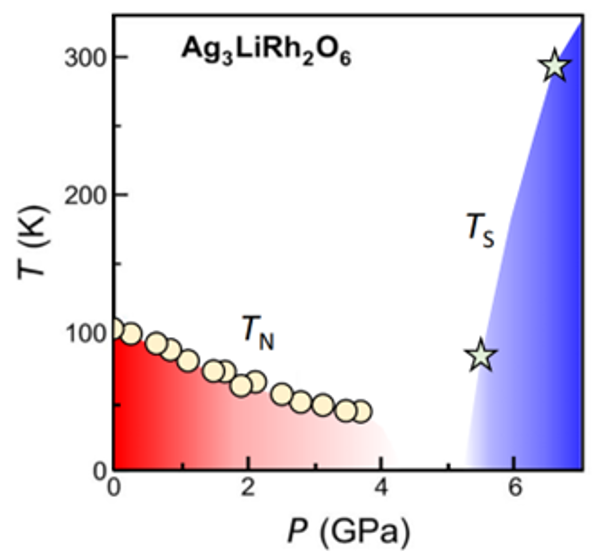
A recent study examined the properties of bilayer nickelates under high pressure, motivated by the discovery of superconductivity in certain compounds. Researchers created a phase diagram showing how pressure and chemical composition interact. They found surprising links between superconductivity and specific bond angles. The study highlights Tb3Ni2O7 as a potential candidate for superconductivity at normal pressure and emphasizes the varied structural and electronic phases that could lead to new superconducting materials.

Accelerating Superconductivity Discovery through Deep Learning

6/25/2025 | Peter Hirschfeld and Richard Hennig (University of Florida)

Researchers are using deep learning to speed up the search for new high-temperature superconductors, which are materials that can conduct electricity without resistance. They developed a model that predicts a key property related to superconductivity by first calculating that property for 818 materials. By incorporating specific knowledge into the model, they achieved much better predictions than random methods. This approach could significantly enhance the discovery of superconductors, showing promise for future materials research even when data is scarce.

NSF Logo

Any opinions, findings, and conclusions or recommendations expressed on this website are those of the participants and do not necessarily reflect the views of the National Science Foundation or the participating institutions. This site is maintained collaboratively by principal investigators with Designing Materials to Revolutionize and Engineer our Future awards, independent of the NSF.

DMREF Logo