Research Highlights

A Quantum Superhighway for Electrons
9/25/2025 | Fan Zhang (University of Texas - Dallas)
In a paper, researchers report the quantum anomalous Hall effect in a rhombohedral pentalayer graphene–monolayer WS2 heterostructure. Unlike previous QAHE systems, this one needs no magnetic elements or moiré patterns. At charge neutrality, QAHE with C = ±5 appears up to about 1.5 K. The effect stems from strong electron correlations in flat bands, gate tuning, and proximity-induced Ising spin-orbit coupling. This points to new possibilities for 2D materials and chiral Majorana edge states.
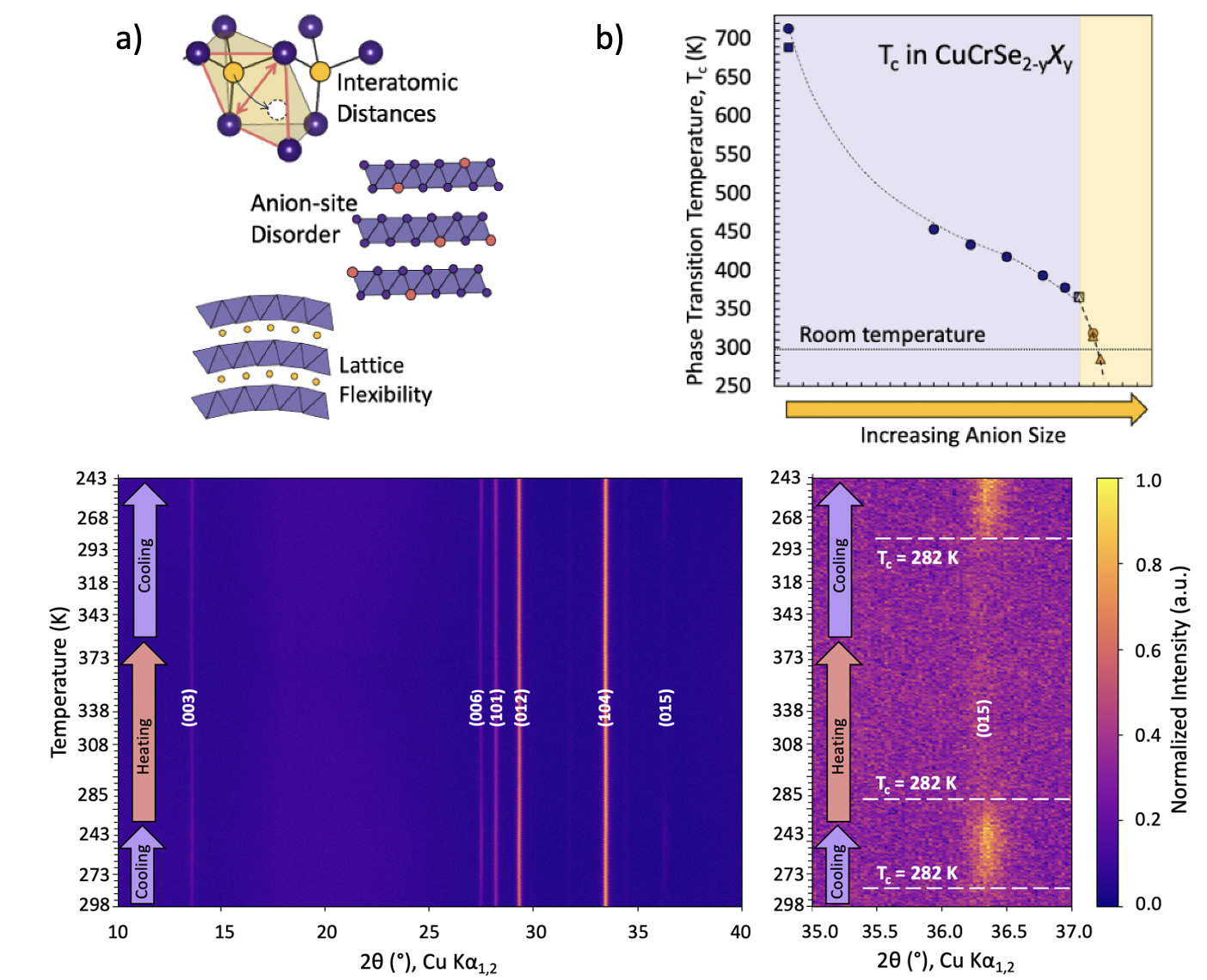
Controlling the Order–Disorder Transition Temperature through Anion Substitution in CuCrX2 (X= S, Se, Te)
9/23/2025 | Alexandra Zevalkink (Michigan State University)
Paper: Controlling the Order–Disorder Transition Temperature through Anion Substitution in CuCrX2 (X= S, Se, Te). In CuCrSe2, substituting S or Te on the anion site shifts order–disorder transition, with Te reaching 282 K—the lowest for this structure. Structural and elastic data tie the trend to bond-length and lattice stiffness: larger anions expand distances and soften bonds, promoting cation disorder. This shows bonding-stiffness tuning by anion alloying can steer thermodynamics of order–disorder transitions in ionic conductors.
Liquid-like Dynamics in a Solid-state Lithium Electrolyte
9/23/2025 | Olivier Delaire (Duke University)
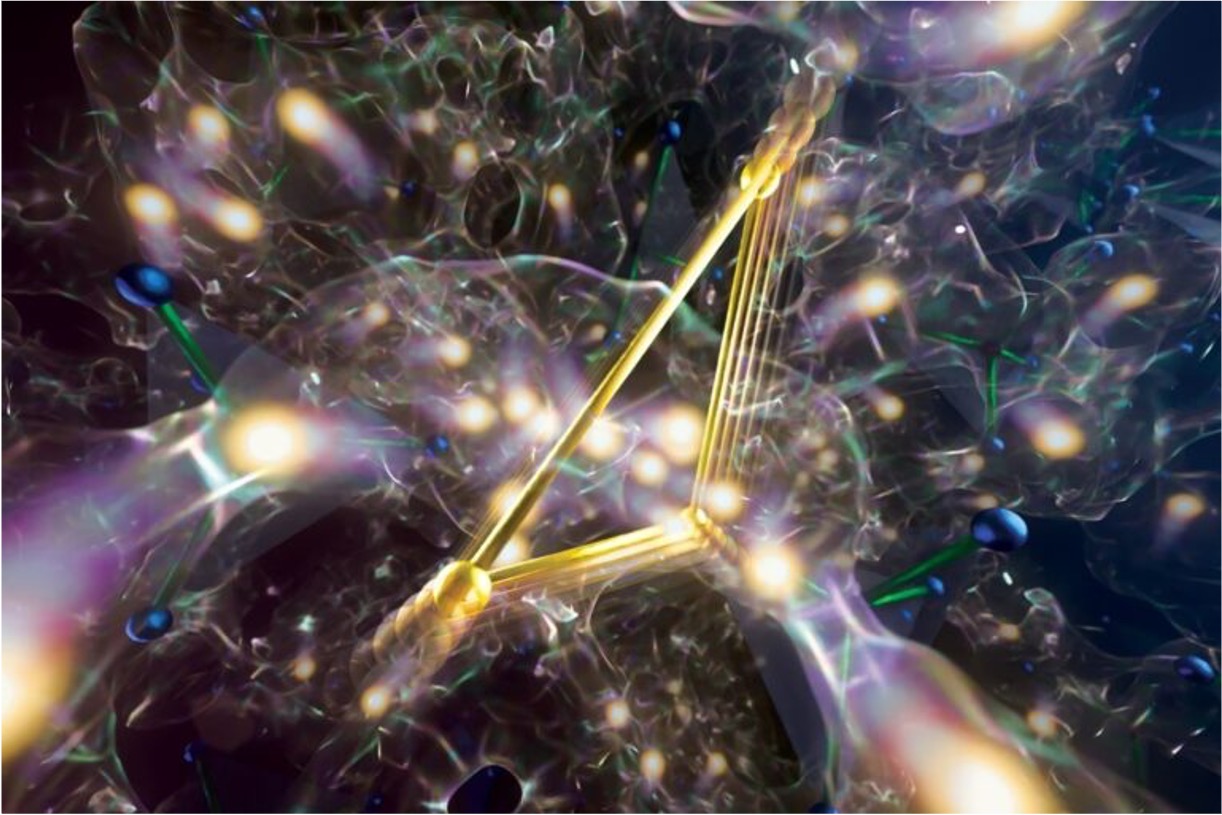
In a paper, researchers reveal liquid-like dynamics in a solid lithium electrolyte, Li6PS5Cl. They show a crossover from crystal vibrations to relaxed, liquid-like ionic motion. Using inelastic and quasi-elastic neutron scattering plus machine-learned, first-principles simulations, they find the way vibration levels are spread departs from the Debye model. The diffusion appears as overdamped phonon modes with a distribution, and coupling between lattice phonons and Li bottleneck breathing boosts diffusivity tenfold. This helps guide energy storage.
Topological Crystal Structure Prediction
9/23/2025 | Mark Tuckerman(New York University)
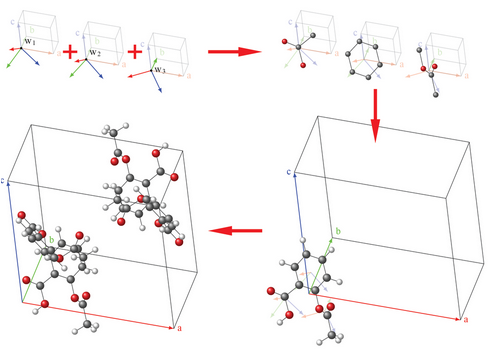
This study introduces a topological approach to predicting organic molecular crystal structures from a 2D diagram alone, without relying on a specific interatomic interaction model. It assumes molecules align with crystal directions and heavy atoms sit at minima of geometric order parameters. By minimizing an objective function that encodes orientations and positions, and filtering candidates by van der Waals volume and contact patterns from the Cambridge Structural Database, it can predict stable structures and polymorphs.
Hybrid Metamaterials with Integrated Magnetic and Plasmonic Non-Noble Metal Nanostructures
9/16/2025 | Edwin Garcia and Haiyan Wang (Purdue University)
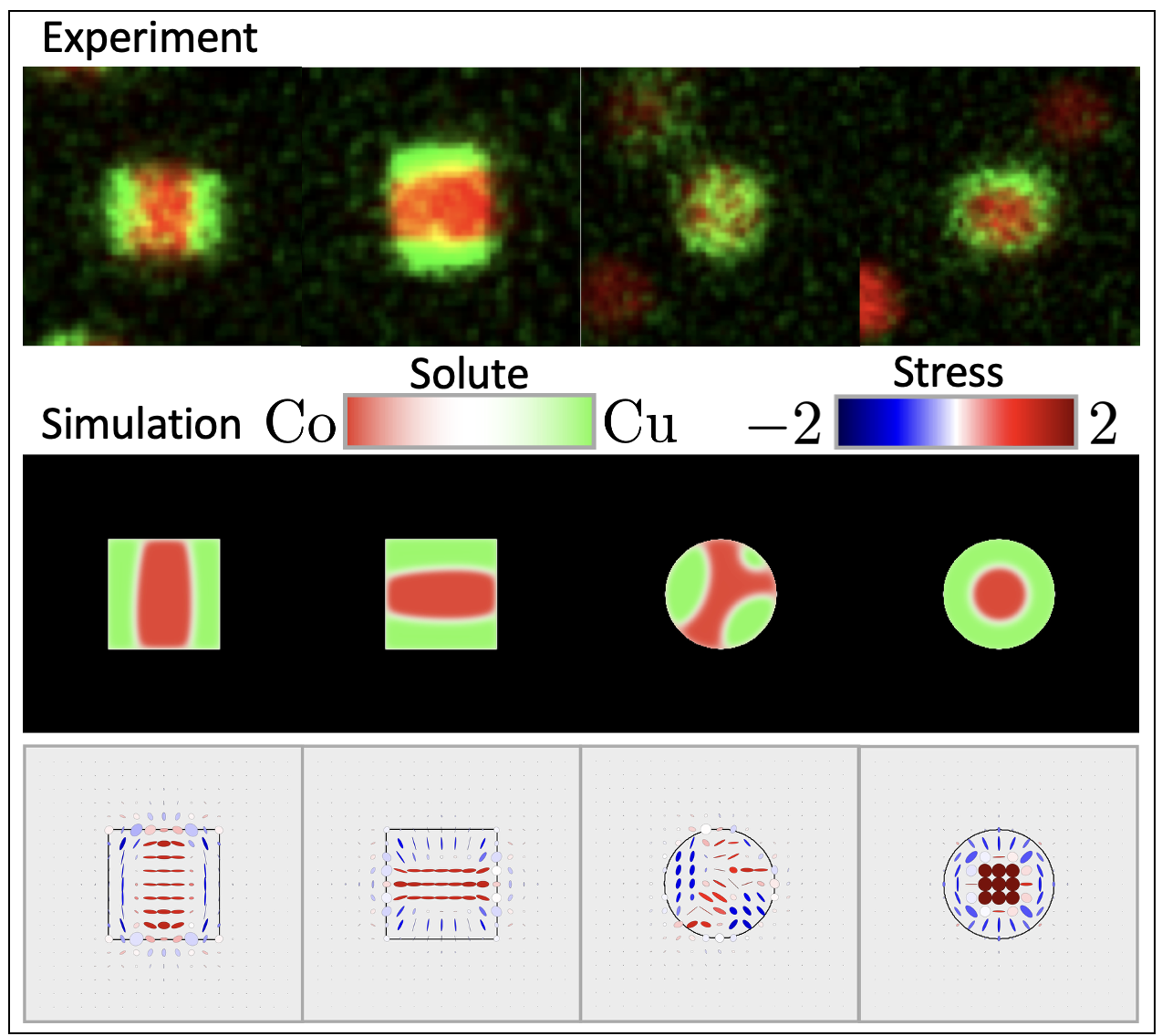
This paper introduces a numerical framework to simulate how multicomponent metallic pillars form inside a BaTiO3 matrix used in hybrid metamaterials, by coupling diffusion with mechanical stress. It reproduces the observed Co-Cu pillar morphology and explains a copper outer shell as the result of competing mechanical and chemical energies. Shapes that lower internal stresses are favored: square pillars tend to candy-like forms, while circular ones move toward core–shell as more Cu is added.
Nanostructures CeO2 for Sensing and Energy Device Applications
9/16/2025 | Haiyan Wang (Purdue University)
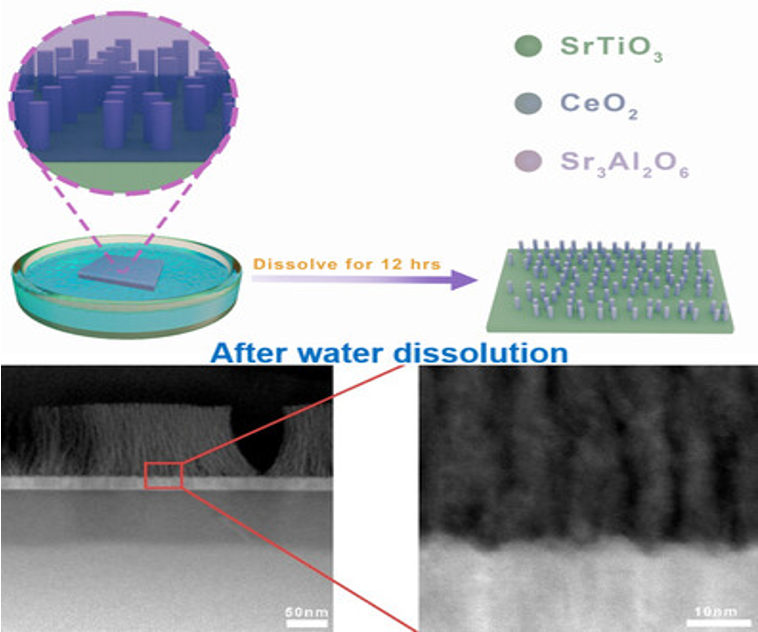
Researchers report a chemical-free way to make tunable CeO2 nanostructures with a water-soluble VAN template, addressing size limits of traditional templates and opening routes for sensors, fuel cells, and catalysis. They used a water-based method to grow CeO2 from SAO–CeO2 VAN thin films. By adjusting CeO2 concentration, they created shapes from nanopillars to nanoporous films. The structures show good heat stability, making them suitable for high-temperature gas sensing, catalysis, and energy devices.

Freestanding BaTiO3-Au Vertically Aligned Nanocomposite: Toward a Flexible Multi-sensing Platform
9/16/2025 | Haiyan Wang (Purdue University)
This paper reports a flexible, multifunctional sensor platform built from freestanding BaTiO3–Au vertically aligned nanocomposite (VAN) thin films. Using a water-soluble Sr3Al2O6 buffer, the VAN films were transferred onto PDMS, yielding devices. The Au nanopillars in BaTiO3 give coupled piezoelectric and plasmonic functions, with films remaining flexible and recoverable and maintaining stable piezoelectric output for pressure sensing. The platform also demonstrates surface-enhanced Raman sensing of 4-mercaptobenzoic acid, enabling integrated mechanical and chemical sensing for wearables.
Solitonic Superfluorescence Paves Way for High-Temperature Quantum Materials
9/12/2025 | Volker Blum (Duke University) Franky So, Kenan Gundogdu (NC State Univ.)
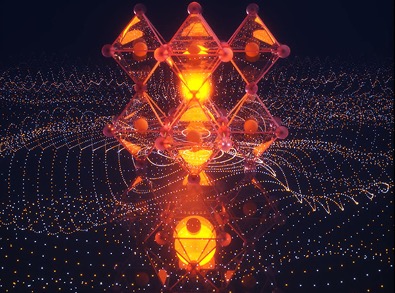
This paper shows that fast thermal motion normally breaks quantum coherence, but in lead-halide perovskites, synchronized polaronic lattice oscillations accompany collective electronic emission during superfluorescence. Researchers built an effective field model showing exciton-lattice interactions create a new, entangled extended polaronic state once a critical polaron density is reached. The work links transient superfluorescence after impulsive excitation to temperature-driven phase transitions, and highlights lattice–electron interactions as keys to making high-temperature macroscopic quantum effects in solids.
Spin-orbit Enabled Unconventional Stoner Magnetism
9/5/2025 | Michael Weinert and Daniel Agterberg (University of Wisconsin - Milwaukee)
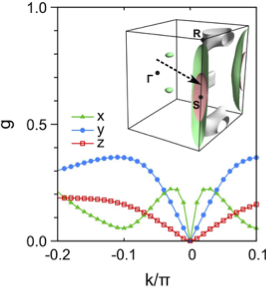
A recent study explored the Stoner instability in metallic ferromagnets, revealing how it can be used to create a new type of magnetism. This unconventional magnetism features unique spin behaviors and has important implications for spintronics, a field focused on electronic devices that exploit spin. The research highlighted how pseudospin can show unusual symmetries which stop it from interacting with magnetic fields, particularly in materials with spin-orbit coupling.
Unveiling the Link between the Anomalous Hall Effect and Ferromagnetism in Altermagnets
9/5/2025 | Daniel Agterberg (University of Wisconsin)
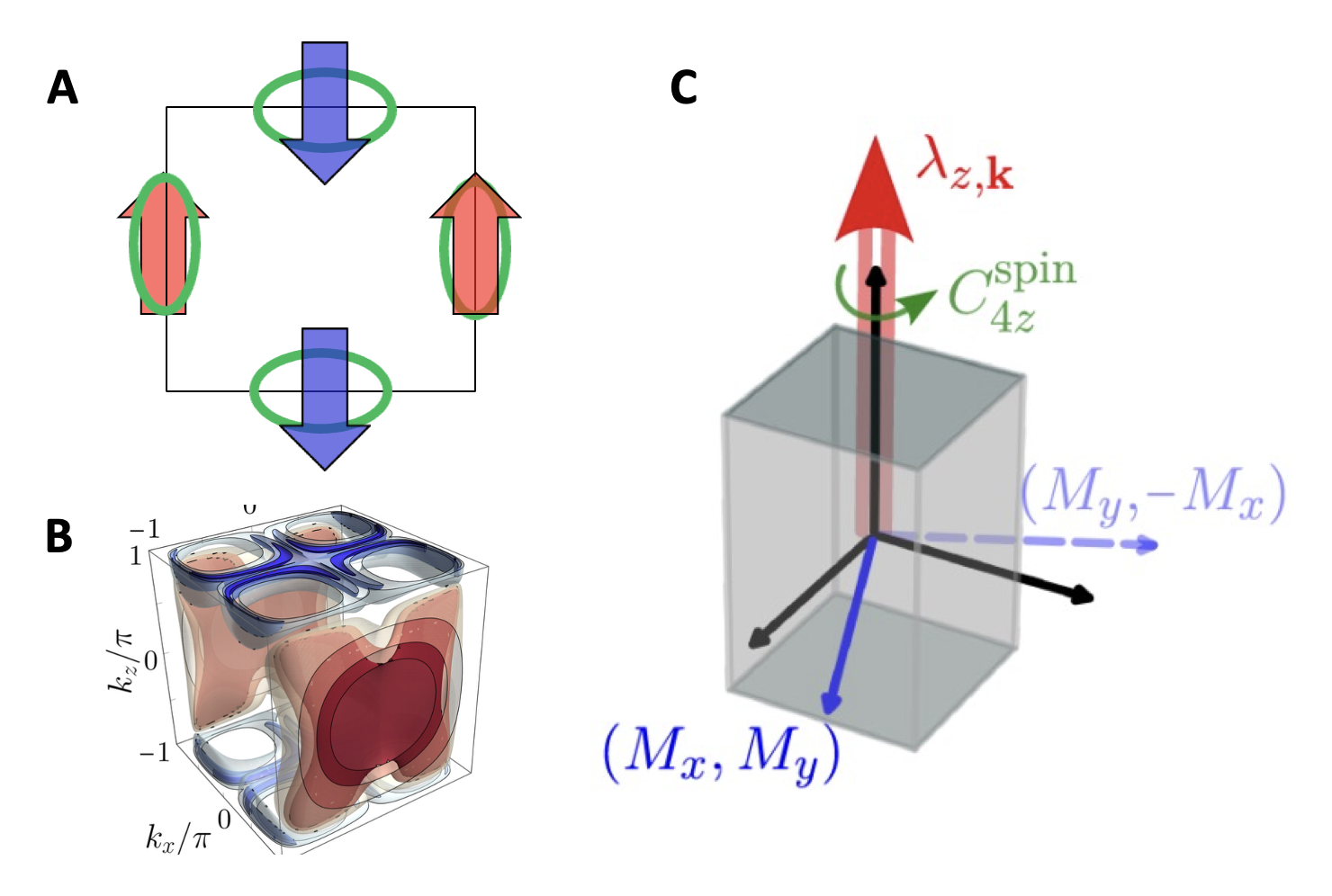
Researchers explored how to control the magnetic Néel vector in a new type of material called altermagnets. They found that two magnetic phenomena, spin-orbit coupling induced ferromagnetism and the anomalous Hall effect, behave differently in some altermagnets. By using simple models, they identified a key symmetry that explains these differences. This insight helps clarify how these important properties relate, which could advance the use of altermagnets in various applications.
Showing 51 to 60 of 245