Research Highlights
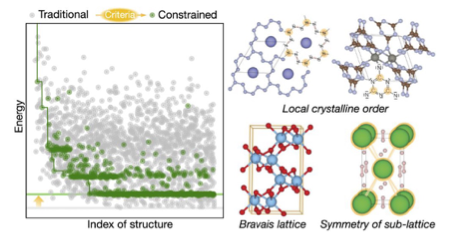
Evolutionary Algorithm for the Discovery and Design of Metastable Phases
6/20/2025 | Eva Zurek (SUNY-Buffalo)
A new method has been developed using the XtalOpt evolutionary algorithm to predict metastable materials, which are less stable but useful in nature and technology. Unlike traditional methods that only find the most stable structures, this approach can identify materials with specific features like crystal order and symmetry. The method successfully discovered various low-energy metastable phases, including some already known experimentally. XtalOpt is openly available, enhancing collaboration in research and development.
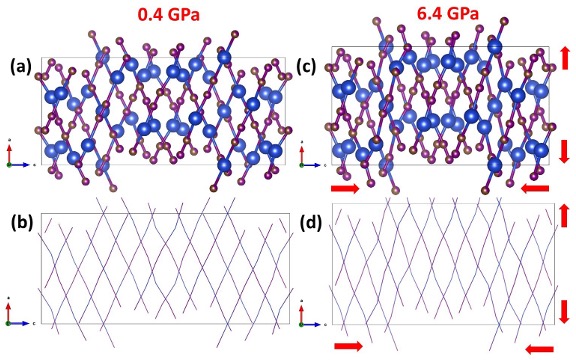
Discovery of Giant “Wine-Rack” Negative Linear Compressibility in Copper Cyanide
6/20/2025 | Russell Hemley (University of Illinois-Chicago)
Researchers have found that copper cyanide (CuCN) displays a unique behavior known as giant negative linear compressibility (NLC), which allows it to expand in one direction under pressure. Unlike other materials, CuCN maintains this large NLC over a wide pressure range due to a special "wine-rack" compression mechanism. This discovery has potential applications in areas like pressure sensors, aerospace, seismic monitoring, and creating impact-resistant materials.
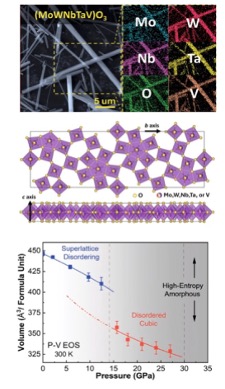
A New Pathway to Resilient Materials
6/20/2025 | Sara Kadkhodaei and Russell Hemley (University of Illinois-Chicago)
Researchers have developed a new type of high-entropy oxide nanoribbon that combines multiple elements, making it more stable and durable. These materials can withstand extreme temperatures, high pressures, and exposure to harsh chemicals, unlike traditional high-entropy materials that often break apart. Additionally, these nanoribbons can be easily 3D-printed or spray-coated, offering a cost-effective way to create strong coatings and improve energy storage for practical applications.
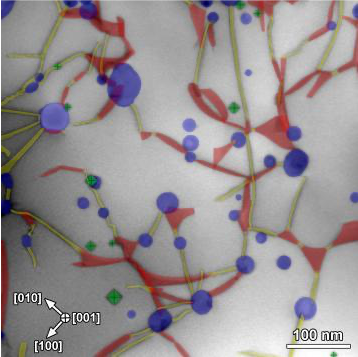
A 3D Printable Alloy Designed for Extreme Environments
6/16/2025 | Michael Mills (Ohio State University)
Researchers have developed a new 3D printable alloy called GRX-810, which is significantly stronger and more durable under extreme temperatures than existing alloys. This innovative material combines nickel, chromium, and cobalt in equal parts and is enhanced with tiny oxide particles to boost its strength. Using 3D printing techniques, GRX-810 offers efficient manufacturing at a lower cost. It can withstand temperatures over 2,000 degrees Fahrenheit and sets the stage for future advanced materials through computer modeling and additive manufacturing.
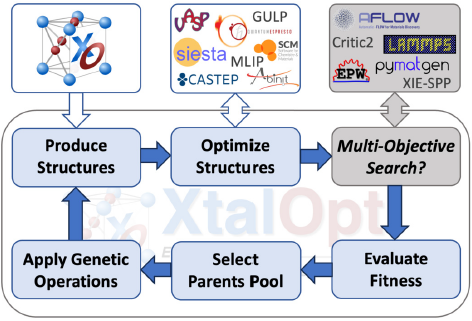
XtalOpt: Multi-objective Evolutionary Search for Novel Functional Materials
2/4/2025 | Eva Zurek (SUNY-Buffalo)
In the new version of the XtalOpt code, a general platform for multi-objective global optimization is implemented. This functionality is designed to facilitate the search for (meta)stable phases of functional materials through minimization of the enthalpy of a crystalline system coupled with the simultaneous optimization of any desired properties that are specified by the user.
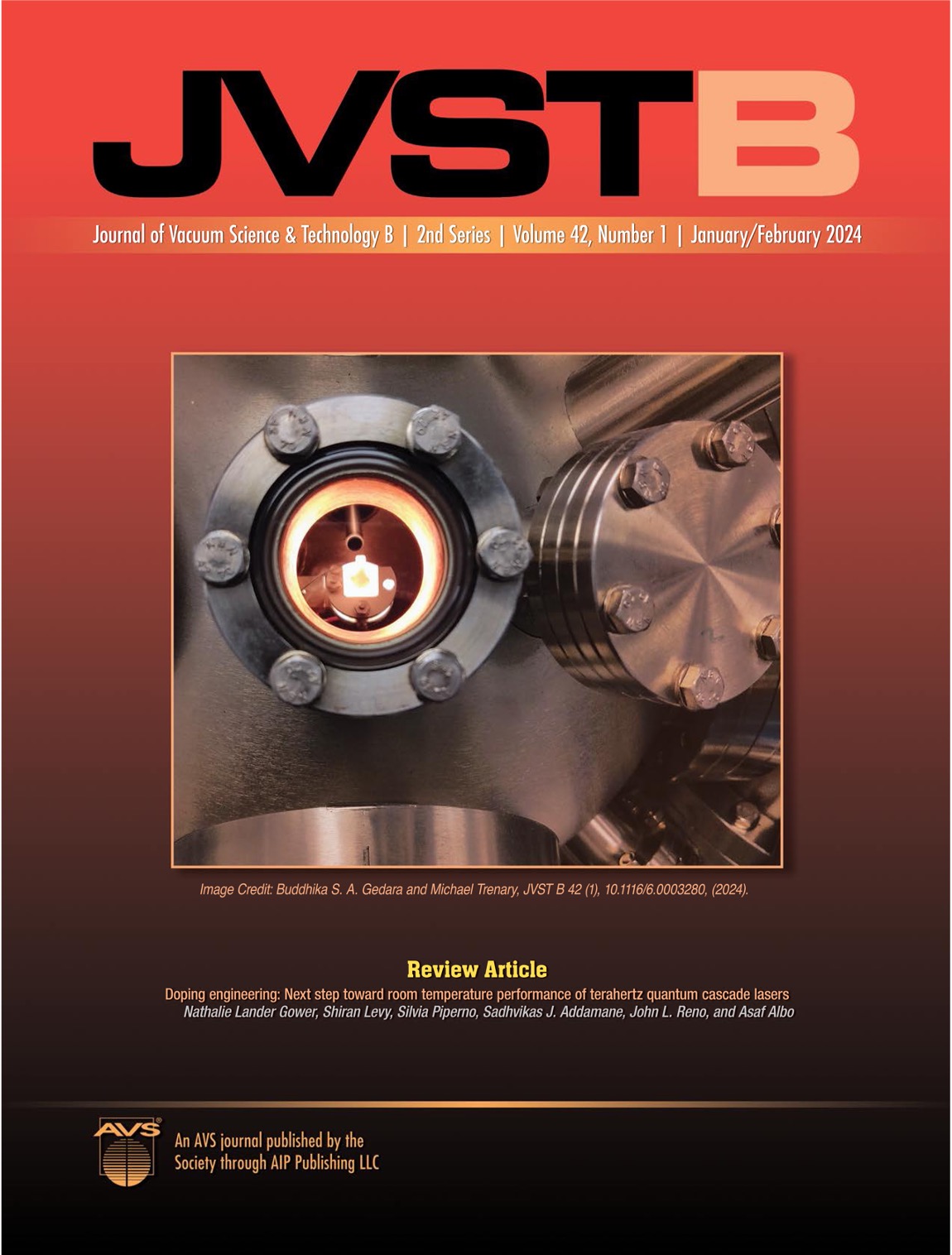
Heating Samples to 2000° C for Scanning Tunneling Microscopy Studies in Ultrahigh Vacuum
2/4/2025 | Michael Trenary (U. Illinois - Chicago)
A simple device for heating single-crystal samples to temperatures ≥2000 °C in ultrahigh vacuum that is compatible with the standard sample plates used in a common commercial scanning tunneling microscope (STM) is described.
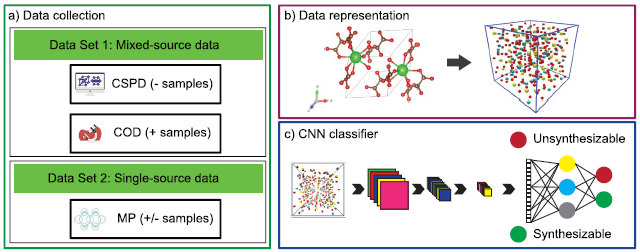
Impact of Data Bias on Machine Learning for Crystal Compound Synthesizability Predictions
2/4/2025 | Sara Kadkhodaei (U. Illinois - Chicago) Eva Zurek (SUNY – Buffalo)
Machine learning models are susceptible to being misled by biases in training data that emphasize incidental correlations over the intended learning task. In this study, the impact of data bias is demonstrated on the performance of a machine learning model designed to predict the likelihood of synthesizability of crystal compounds.

Virtual Node Graph Neural Network for Full Phonon Prediction
12/11/2024 | Mingda Li (MIT)
Understanding the structure–property relationship is crucial for designing materials with desired properties. The past few years have witnessed remarkable progress in machine-learning methods for this connection.

Machine Learning Detection of Majorana Zero Modes From Zero-bias Peak Measurements
12/11/2024 | Mingda Li (MIT)
A machine learning method has been developed to detect Majorana zero modes (MZMs) from experimental data, achieving significant accuracy. This approach utilizes quantum transport simulations and topological data analysis, providing a simpler and more effective method to identify these quantum states, crucial for the advancement of fault-tolerant quantum computing.
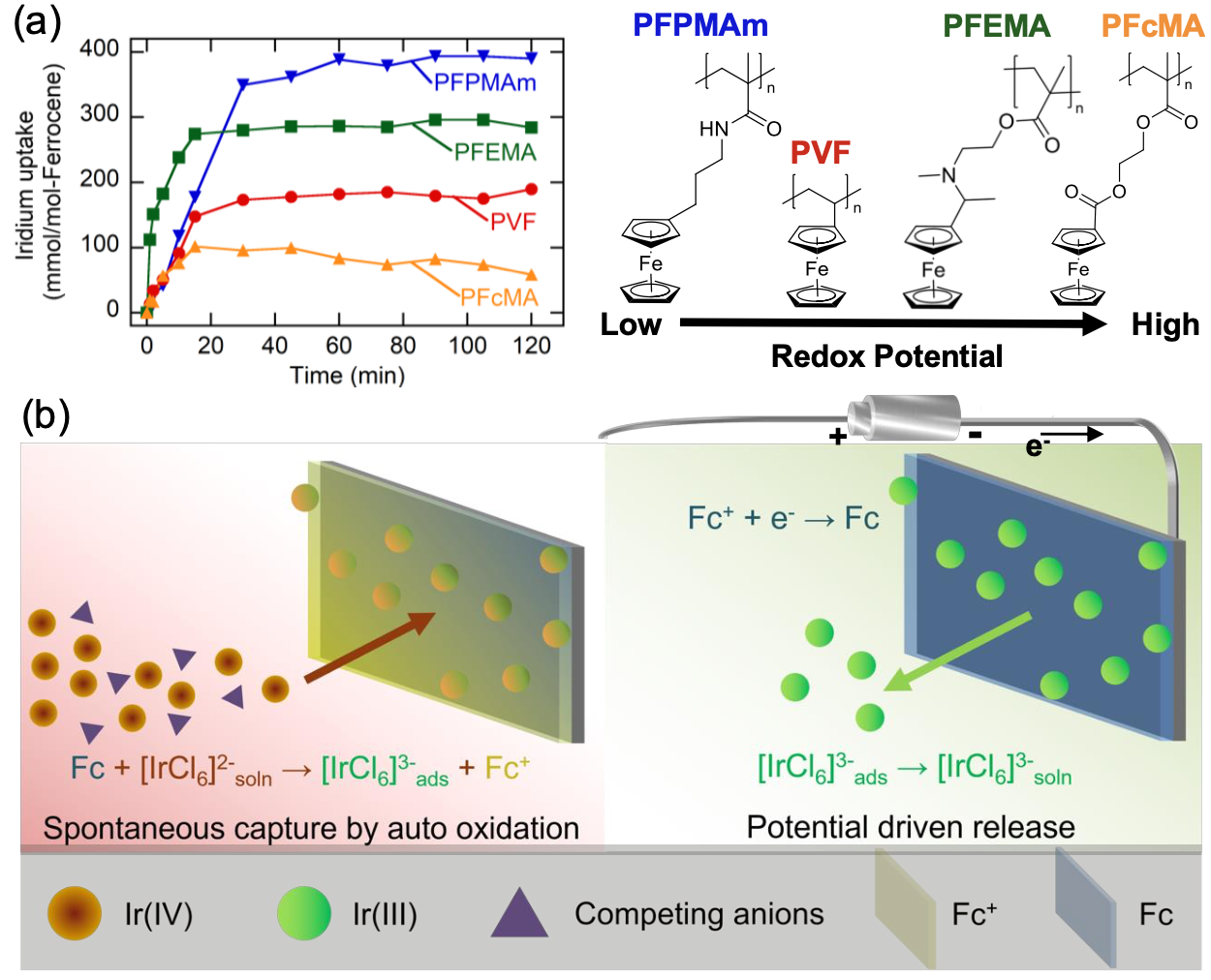
Selective Recovery of Platinum Group Metals
11/21/2024 | Xiao Su (University of Illinois Urbana-Champaign)
In this work, we applied four different metallopolymers with tunable redox-potentials and demonstrated their molecular selectivity in multicomponent PGM mixtures. Results showed that lower redox potential of the metallopolymer had higher uptake at OCP.
Showing 81 to 90 of 245